The Other Way In: because knowing the book is only part of the story

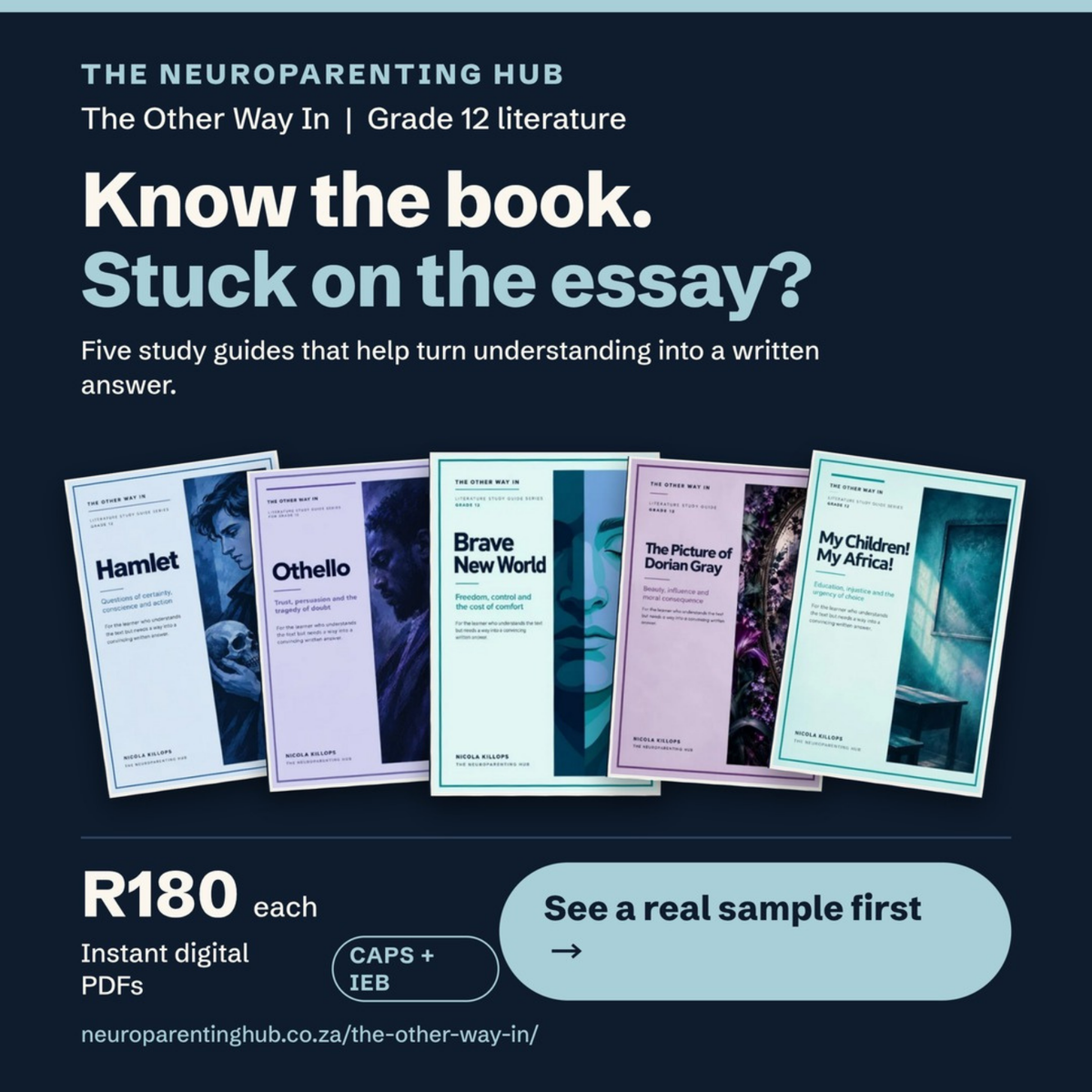
Introducing a growing collection of matric literature study guides that make room for different ways of thinking without compromising academic depth. I've always loved teaching literature. Give me a classroom full of teenagers arguing about whether a character is misunderstood, manipulative, morally bankrupt or simply making spectacularly bad decisions, and I'm happy. Literature gives us so much to work with. Human behaviour, power, prejudice, love, betrayal, identity, society. It invites us to question people's motives, consider different perspectives and occasionally discover that the character we were so confidently defending is actually rather awful. And teenagers can be wonderfully good at that. But I've seen something repeatedly over my years in education. A learner can have a fascinating conversation about a novel or play, make connections that weren't immediately obvious and offer a genuinely thoughtful interpretation, then sit down to write an essay that barely reflects the discussion. Sometimes the problem is understanding. Sometimes it's knowing how to build an argument. Sometimes it's the effort involved in organising, retrieving and expressing ideas under pressure. And sometimes it's all three. The frustrating part is that these very different difficulties can look remarkably similar on an examination paper. A mark doesn't necessarily tell us which one we're dealing with. So I started building something The Other Way In grew out of a question I've returned to throughout my teaching career: how do we make demanding academic work more accessible without compromising the thinking it requires? Working with gifted, neurodivergent and twice-exceptional learners has shown me how misleading academic performance can be when we don't understand what's happening behind it. A learner might recognise complex patterns and connections but struggle to organise ideas sequentially. Another might remember every detail of a text yet find it difficult to move beyond retelling the plot. Someone else might understand the question perfectly well but have no idea how to begin answering it. And sometimes a learner simply needs a clearer explanation and more practice. I began developing literature guides that respond to those differences while keeping the richness of the texts intact. No Shakespeare stripped down until there's very little Shakespeare left. No pretending that a collection of memorised quotations is the same thing as literary understanding. Instead, different ways into the material, explicit teaching of academic skills and plenty of opportunities to think. That's how The Other Way In became a growing collection of Grade 12 literature study guides from The Neuroparenting Hub. Let's take Othello Most learners can tell you that Iago manipulates Othello into believing Desdemona has been unfaithful. They know jealousy is a central theme and that the consequences are tragic. Fine. That's a starting point. But how does Iago's manipulation actually work? What does he know, and what does he merely suggest? Why does Othello begin treating suspicion as evidence? How does Shakespeare position the audience to recognise things that Othello cannot? And at what point does Othello's responsibility for his own decisions become impossible to ignore? Now we're getting somewhere. We're examining evidence and belief, the psychology of manipulation and the way Shakespeare constructs a tragedy. We're also developing the foundations of a much stronger literary argument. The guides help learners work through that thinking deliberately: noticing details, finding evidence, interpreting it, questioning their first conclusions and developing a reasoned response. Sometimes that involves mapping relationships visually. Sometimes it's examining a character's decisions from several perspectives, working through a structured question or building an argument aloud before writing it. Different approaches, depending on what the task demands. The intellectual expectations remain. Accessible doesn't mean easy There's a misconception that making education more accessible means making it easier. If a learner can engage with complex ideas but struggles to organise an essay, giving them simpler ideas doesn't address the difficulty. Equally, if they haven't understood the text, handing them an essay template isn't going to solve the problem. A visually minded learner might benefit from seeing how characters, events and themes connect. Someone who enjoys debate might develop an argument through discussion before writing it. Another learner may need worked examples and direct instruction in constructing analytical paragraphs. And the same learner may need different approaches on different days, or for different tasks. I'm not particularly interested in putting children into boxes labelled according to how they're supposedly designed to learn. I'd much rather give them useful tools, teach them how to use those tools and help them work out which ones are actually helpful. The books are still the point Hamlet raises questions about conscience, grief, revenge and the difficulty of knowing what is true. The Picture of Dorian Gray gives us plenty to argue about when it comes to beauty, influence, morality and responsibility. Brave New World asks uncomfortable questions about freedom, happiness and the price of social stability. These aren't texts that deserve to be reduced to a few themes and a handful of quotations to memorise. The guides include the practical material learners expect: explanations, character analysis, context, themes, quotation work and examination-writing support. But they also encourage learners to question an interpretation, reconsider a first impression and recognise that a convincing argument needs evidence. And occasionally to disagree. Preferably with a good reason. A thought for parents during exam season We're in the middle of matric examinations, and I know many households are currently operating somewhere between revision timetables, cups of coffee and varying degrees of panic. If your teenager is struggling with literature, it may help to work out exactly what's difficult before adding another three hours of studying to the timetable. Can they explain the story and characters? Do they understand what the question is asking? Can they find evidence for their interpretation? Can they organise those ideas into an argument? The answers can point to quite different needs. If your teenager is open to it, ask them to explain an argument aloud. You don't have to know the book particularly well. Just ask why they think something, what in the text supports it and whether there's another way of looking at the situation. You might be surprised by the discussion. Or you might be told, quite firmly, that they'd prefer to get on with it themselves. Also perfectly reasonable. They are young adults, after all. A look inside The Other Way In The growing collection includes: - Hamlet by William Shakespeare - Othello by William Shakespeare - Brave New World by Aldous Huxley - The Picture of Dorian Gray by Oscar Wilde - My Children! My Africa! by Athol Fugard - Life of Pi by Yann Martel - The White Tiger by Aravind Adiga The Crucible by Arthur Miller is also part of the expanding series, with sample material available to explore. The downloadable guides are R180 each. I've also put together a free 42-page sample collection, with extracts from seven titles. It's there so parents, learners and educators can see the level of analysis, explore the different approaches and decide whether the material is useful for them. "Explore The Other Way In and view the free samples" (https://www.neuroparentinghub.co.za/the-other-way-in/) I developed these guides because I love seeing learners make connections, question assumptions and discover that they have something worthwhile to say about a text. I also know how discouraging it can be when a learner has put in the work but can't turn that understanding into the answer an examination expects. Both deserve our attention. And if the guides happen to inspire a teenager to argue passionately about Shakespeare at the dinner table, I'll consider that a rather lovely bonus. Nicola Killops Founder, The Neuroparenting Hub Gifted and twice-exceptional education specialist