What Children Learn About Themselves From Us

Children are remarkably good at reading adults.
Long before they can explain executive functioning, sensory overload or the particular misery of being given six instructions at once, they can tell when they are the child who takes too long. The one who talks too much. The one who needs reminding. The one whose name is said with a little more meaning than the others.
They notice the sigh. They notice the look exchanged across the room. They notice when a teacher’s patience thins or a parent’s voice changes halfway through the same request.
What they often do not know is why the thing everyone else seems to manage so easily feels so difficult for them.
I have taught children who understood the work, could explain the answer and still could not begin. I have watched bright children stare at a page as though it had personally offended them. I have seen children hold themselves together for an entire school day and unravel in the car park because the wrong snack had been packed.
From the outside, these moments are easily interpreted as laziness, distraction, overreaction or a lack of effort. Once those words are used often enough, they begin to sound less like descriptions of a moment and more like descriptions of the child.
A child who is repeatedly told that they are lazy does not usually become more organised. More often, they begin to assume effort is something other people were born with. A child who is told they are too sensitive does not stop feeling overwhelmed. They learn that their experience is inconvenient. A child who is constantly corrected for moving may never discover that movement is one of the ways their body prepares itself to think.
Children learn very quickly how difficult they are for other people. They are taught far less about how their own minds work.
A child who can say, “I need help finding the first step,” is in a very different position from one who believes they are bad at starting. A child who understands that noise makes it harder to think can begin to notice when a classroom, party or busy family gathering is becoming too much. A child who knows they need to talk something through before they can act is not making excuses. They are learning to recognise a pattern.
This kind of self-awareness does not make children less accountable. It makes them more able to take part in what happens next.
They can still be expected to finish the task, repair the friendship or return to the discussion. The difference is that they are no longer trying to do so while carrying the additional belief that there is something fundamentally wrong with them.
The difficulty is that adults often see only one part of the child.
A teacher may see a learner who refuses to begin. A parent may see the same child arrive home completely spent and collapse over something that appears absurdly small. A psychologist, occupational therapist or behaviour specialist may recognise anxiety, sensory load, processing difficulty or executive-functioning strain.
Each person may be seeing something true. Problems arise when those truths remain separate.
The school has one explanation. The family has another. A professional writes a careful report full of useful recommendations, which may then be stored somewhere so secure that no one is ever troubled by it again.
The child moves between all of these spaces and is expected to manage the gaps.
Families often become the translators. They explain the child to the school, the school to the therapist and the therapist’s report to everyone else. They repeat the same history, concerns and strategies, hoping that this time the pieces will stay together long enough to make a difference.
They do not always.
This is one of the reasons I have become so interested in creating shared language around a child. Not jargon. Not another set of labels. Language a child can understand and use.
Children need words for the patterns they experience.
They need to know the difference between refusing and not knowing how to begin. Between being careless and losing track of several instructions at once. Between being difficult and becoming overwhelmed. Between making excuses and trying to explain what gets in the way.
That understanding does not remove expectations. It gives the child a better chance of meeting them.
Sometimes the child simply does not feel like doing the work.
Children remain children. No framework has yet eliminated the desire to avoid homework, escape tidying a bedroom or stay in a swimming pool after being asked to get out.
Even then, knowing the child helps.
One child may respond to a clear sequence. Another may need to understand the point of the task. Another may need to move before they can settle. Another may need connection before an instruction has any chance of landing.
The expectation can remain. The route may need to change.
That distinction sits at the centre of the work we are doing through BABS, Breaking All Barriers, and the Integrated Brain Classroom™.
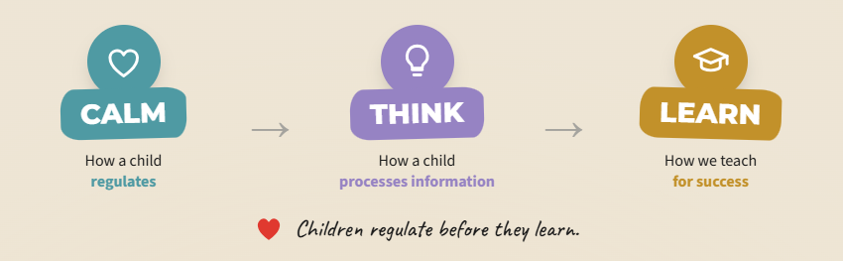
The framework brings regulation, thinking and teaching together because children do not experience them as separate parts of the day. A child who is overwhelmed cannot simply put that feeling aside and continue with long division. A child who cannot organise their thoughts may understand the lesson perfectly well and still appear to be doing nothing. A child who feels misunderstood may stop listening long before the adult has finished explaining.
Calm. Think. Learn. gives children and adults simple language for a far more complex process.
It helps adults consider what a child needs in order to engage, how they tend to process information and what can be adjusted about the route into learning.
More importantly, it gives children language for themselves.
Children should not have to wait until adulthood to discover that there was a reason some things were hard. They should not spend years believing they were careless, dramatic or lazy, only to learn later about working memory, sensory processing, task initiation or the need for predictability.
They deserve that understanding while they are still forming their sense of who they are.
They deserve to know that needing movement does not make them disruptive, that needing time does not make them slow and that asking for the first step is not the same as refusing the task.
They also deserve adults who can see beyond the quickest explanation.
That does not require perfect parents, perfectly regulated teachers or classrooms where nobody ever loses patience. It requires adults who can remain curious for a little longer.
Sometimes that pause is enough to stop a passing difficulty from becoming part of a child’s identity.
The child may still need to open the book. They may simply need help finding a way in.
For more information about BABS and the Integrated Brain Classroom™, visit breakingallbarriers.co.uk.