Please Send a Brief Background


What follows a child into a new classroom, school or support relationship, and what gets left behind
A new school asks for a brief background.
I open the folder, then the folder inside the folder, then the email I saved because it contains the clearest explanation of what actually helped. There are reports from three professionals, an old learner profile, a concessions letter, support meeting notes and a document called “final final latest”, which is neither final nor latest.
The word brief feels slightly ambitious.
What do you include when a child has moved through several schools, assessments, support plans and professionals? The diagnosis? The school history? The strategy that worked beautifully in Grade 5 and failed completely by Grade 7? The teacher who understood him within a week? The year when almost nobody did?
Some reports are still useful, apart from the sections describing a child who has moved on. Some recommendations were exactly right in one classroom and hopeless in another. Some details looked minor at the time but later explained almost everything.
Most parents eventually develop several versions of the story: the two-minute version for a rushed discussion, the fuller one for somebody who genuinely needs the history and the carefully edited version for a new school, where you are trying to be honest without sending a list of difficulties ahead of your child.
Then there is the version your child would tell, which may be very different.
I have spent years on both sides of that exchange. I have been the parent trying to explain a complicated child to someone quickly enough for them to understand him, while trying equally hard to stop him from becoming a summary. I have also been the teacher receiving a file at the start of term, when there are names to learn, routines to establish and several other children whose needs are no less urgent.
As a parent, I wanted the teacher to read everything. As a teacher, I knew what “everything” looked like when it arrived with thirty other sets of information.
Schools need background information. A useful report can save months of confusion, and a short note from a previous teacher may explain something the formal paperwork never captured.
Once something is written down, however, it begins to gather weight. A sentence from one difficult year can follow a learner for the next five. A strength receives one polite line near the bottom of the page, while every difficulty has a heading, a subheading and supporting evidence.
By the time the child arrives, the paperwork may already have introduced them.
The adults know that he avoids written work, struggles with transitions and needs repeated prompting. They may not know that he can explain a difficult idea with startling clarity, remember tiny details about anything he loves or become a different learner once he trusts the person teaching him.
The observations may all have been accurate when they were written. The child may be somewhere else entirely by the time the next person reads them.
Parents carry the parts that never settle neatly into a form. We know when a recommended strategy was tried and made things worse. We know that a child who appears unmotivated may have spent the morning using every scrap of energy to hold himself together. We know why one old incident still matters and why another no longer does.
We do not always explain it well. Sometimes we are tired of telling the same story. Sometimes we arrive at a meeting with twenty pages of evidence and cannot find the one paragraph everybody needs.
There is also the fear of saying too much.
Parents want the next teacher to be prepared, but we know how easily a child can become fixed inside an old description. A diagnosis begins to explain everything, including the things it does not explain at all. A difficult period becomes the permanent introduction.
I have seen the other side of that too. A teacher reads the file because they are trying to help, then spends the first few weeks waiting for the difficulties they have been warned about. The child may sense that expectation before anyone says a word.
The records are necessary. They also need context.
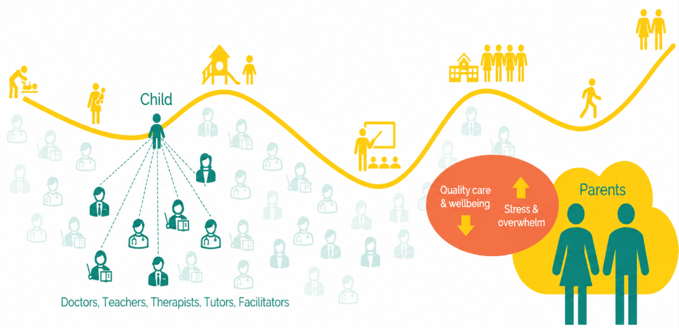
A teacher sees the child during learning, group work, noise, friendship and transition. A parent sees what happens before school, after school and in the evening when the day’s effort catches up. A therapist may see anxiety or sensory strain that never appears in the classroom. Those accounts do not always match. That does not make one of them wrong.
The parent, however, usually becomes the person carrying information between them.
You forward the report to the school, explain the school challenges to the therapist, take the therapist’s recommendation back to the teacher and brief the new professional on what the previous one tried. Each retelling changes because the child has changed, the audience is different or there is no time for the long version.
Transitions expose the gaps. Some history follows the child. Some is shortened. Some remains in a file nobody has opened yet. Occasionally, the most useful information was never written down because it came from an ordinary discussion outside a classroom door.
The child carries the whole history. The adults around them may receive only pieces.
When I met Robby Coelho and heard why he had created Dalza, I recognised the problem straight away. He had experienced it from the parent’s side too and understood how easily families become responsible for carrying every report, update and explanation between people who may each know only one part of the child.
Dalza gives families a secure place to keep information and share selected parts of it with the people they choose, while parents remain in control of who sees what.
Most families already have plenty of reports, usually scattered across inboxes, folders and old email threads. The harder part is keeping hold of the context: what has changed, what still matters, what has already been tried, what helped and what no longer reflects the child.
That is what made sense to me about Dalza. It gives parents a way to keep the history together without having to hand over the whole story every time someone new becomes involved.
The platform is being shaped through conversations with parents, teachers and therapists. It has to work in real life, not only in theory. Parents need to be able to say what helps and what becomes another task. Teachers need to be honest about what is realistic in a classroom. Therapists need to protect professional boundaries and explain what information can and cannot be shared.
Schools and professionals will still have their own systems and responsibilities. Dalza is not trying to replace them. Its role is to help families hold onto the wider picture and share what is relevant without beginning again each time.
People will still see the child differently. A teacher may notice something that never appears at home. A therapist may understand a difficulty hidden in the classroom. A parent may know why a strategy that looks sensible on paper has already failed three times.
Those differences are useful when they come together. Dalza gives parents a way to carry more of that context forward, so the next person begins with more than an old report or a hurried explanation.
The paperwork will never contain the whole child. It can, however, reflect change more accurately, preserve what matters and help the people supporting them understand where to begin.
For families who have spent years carrying the story between schools, professionals and support teams, that could make a very real difference.
About Dalza
Dalza is a secure digital platform designed to help parents gather and manage the information that accumulates around a child’s support journey, including reports, school feedback, professional notes, observations, and updates.
It was founded by Robby Coelho, a father of a child with neurodevelopmental needs and a technology and information protection lawyer, which gives the platform both lived experience and a strong privacy foundation.
Dalza has also been selected for the 2026 Mastercard Foundation EdTech Fellowship, delivered by Injini, which recognises its potential in education and child-support technology.

Contact Dalza hello@dalza.com