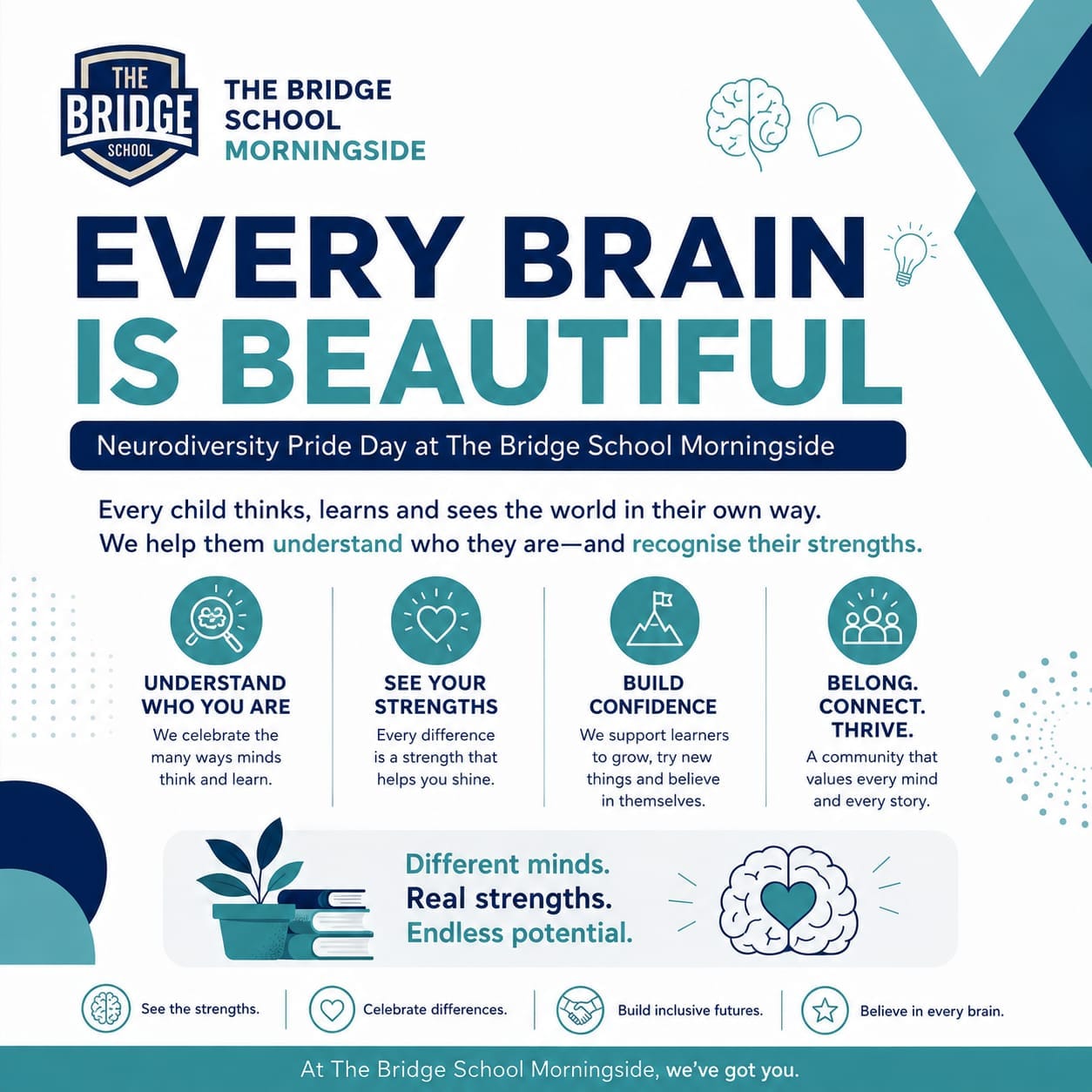
Every Brain is Beautiful
For many children at The Bridge School Morningside, school has not always fitted easily.
Some children need more movement. Some need more time. Some need quiet, structure, repetition, visuals, sensory support or another way into the work. Some read differently. Some communicate differently. Some learn beautifully, but not always in the way a traditional classroom expects.
Their parents know this.
They know the worry that can sit behind even ordinary school days. Will my child be understood? Will they cope? Will the world see what I see? What happens when school ends? What kind of future is there for a child who does not fit neatly into the usual system?
That is why Neurodiversity Pride Day at The Bridge was worth celebrating.
It was not a day that tried to pretend those worries do not exist. It simply offered children another picture of what different is.
This year, The Bridge School Morningside marked the day with Beautiful Brains Around the World, a school-wide activity aligned with the theme Every Brain is Beautiful.
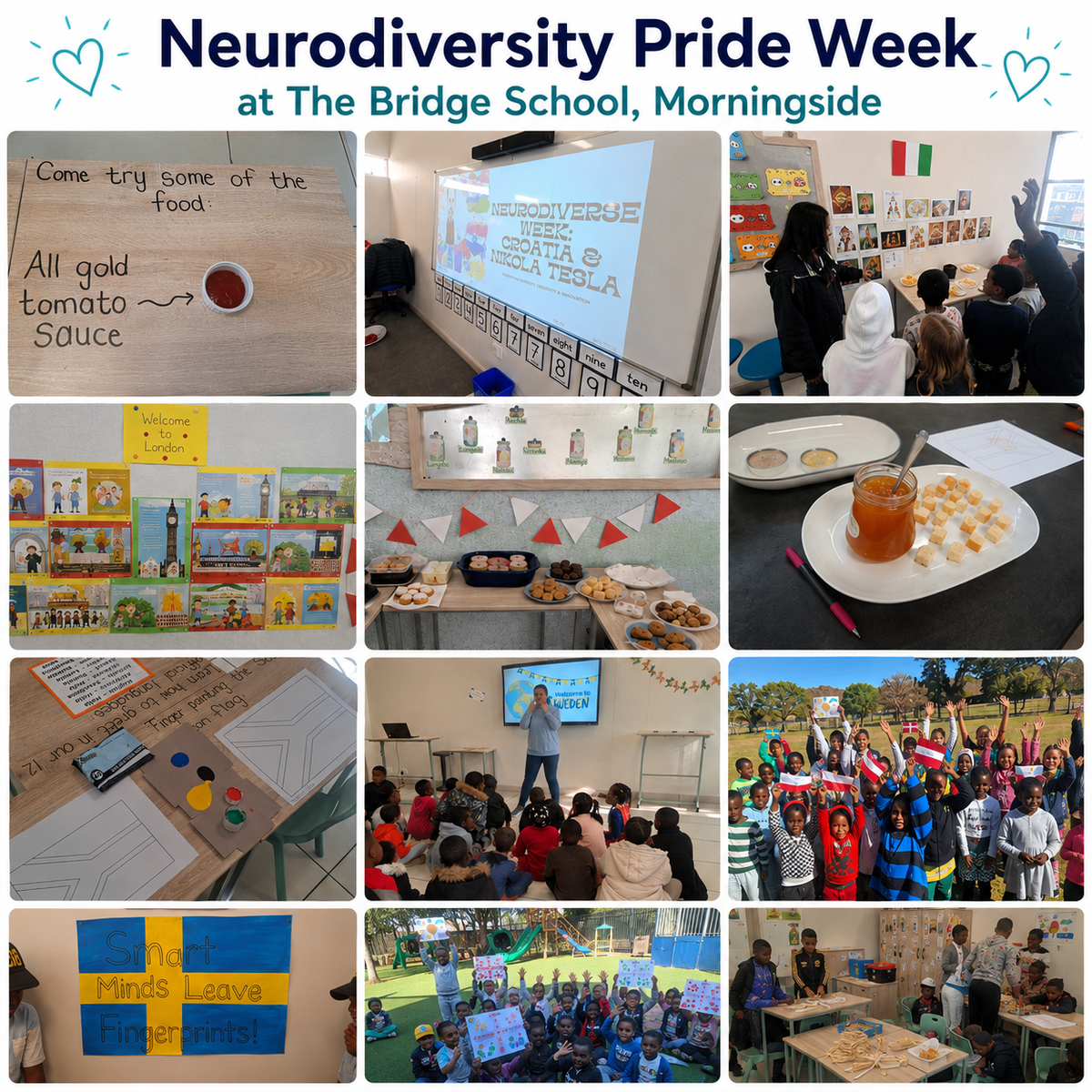
Learners moved through country stations for South Africa, England, Croatia, Italy, Austria and Sweden. Each room had its own person, place and way of thinking. There were maps, pictures, short facts, music, food tasters, activities, display cards and posters for learners to discover as they moved through the school.
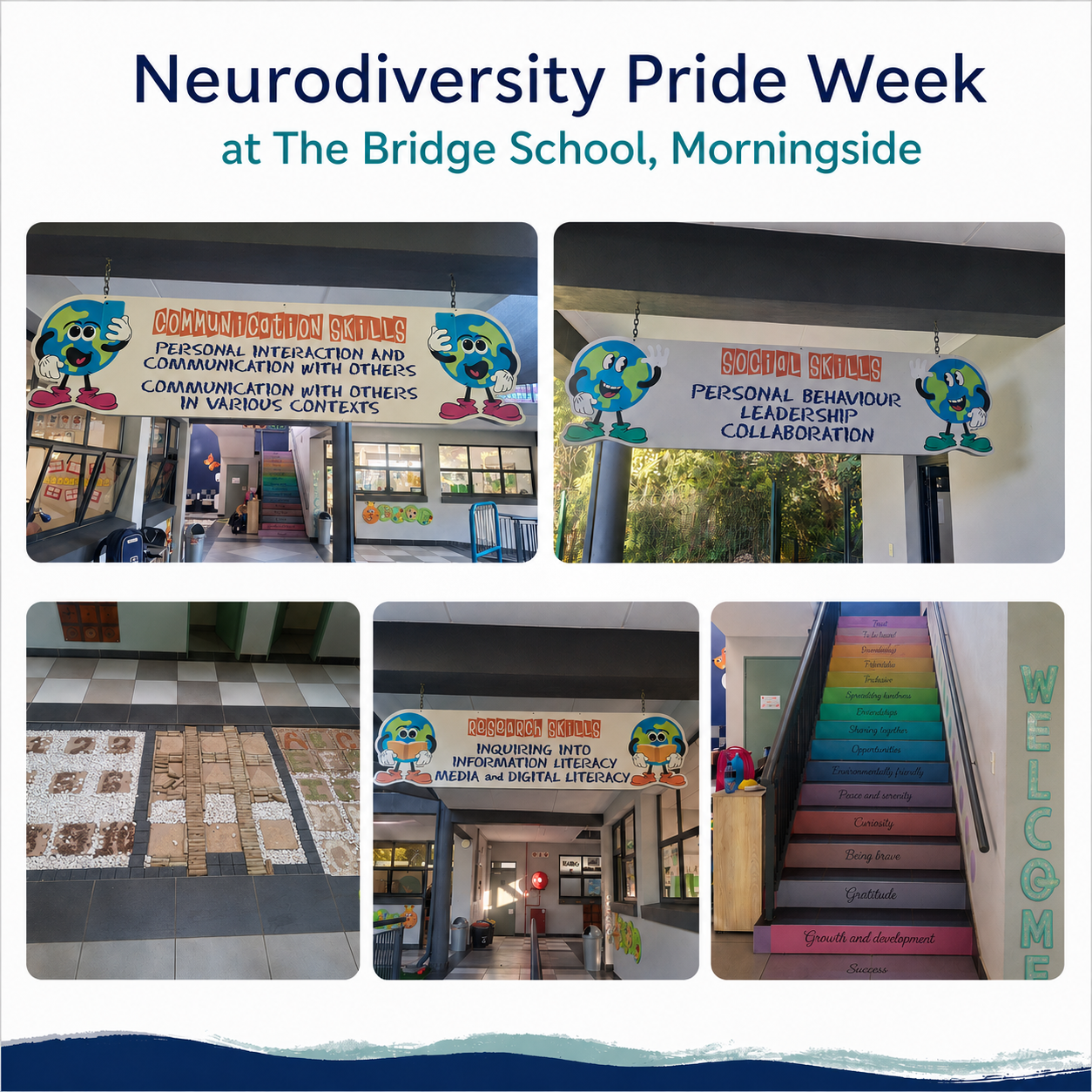
The rooms were not set up to feel like formal lessons. They were closer to small discovery spaces, with enough to look at, touch, taste, read, hear and ask about.
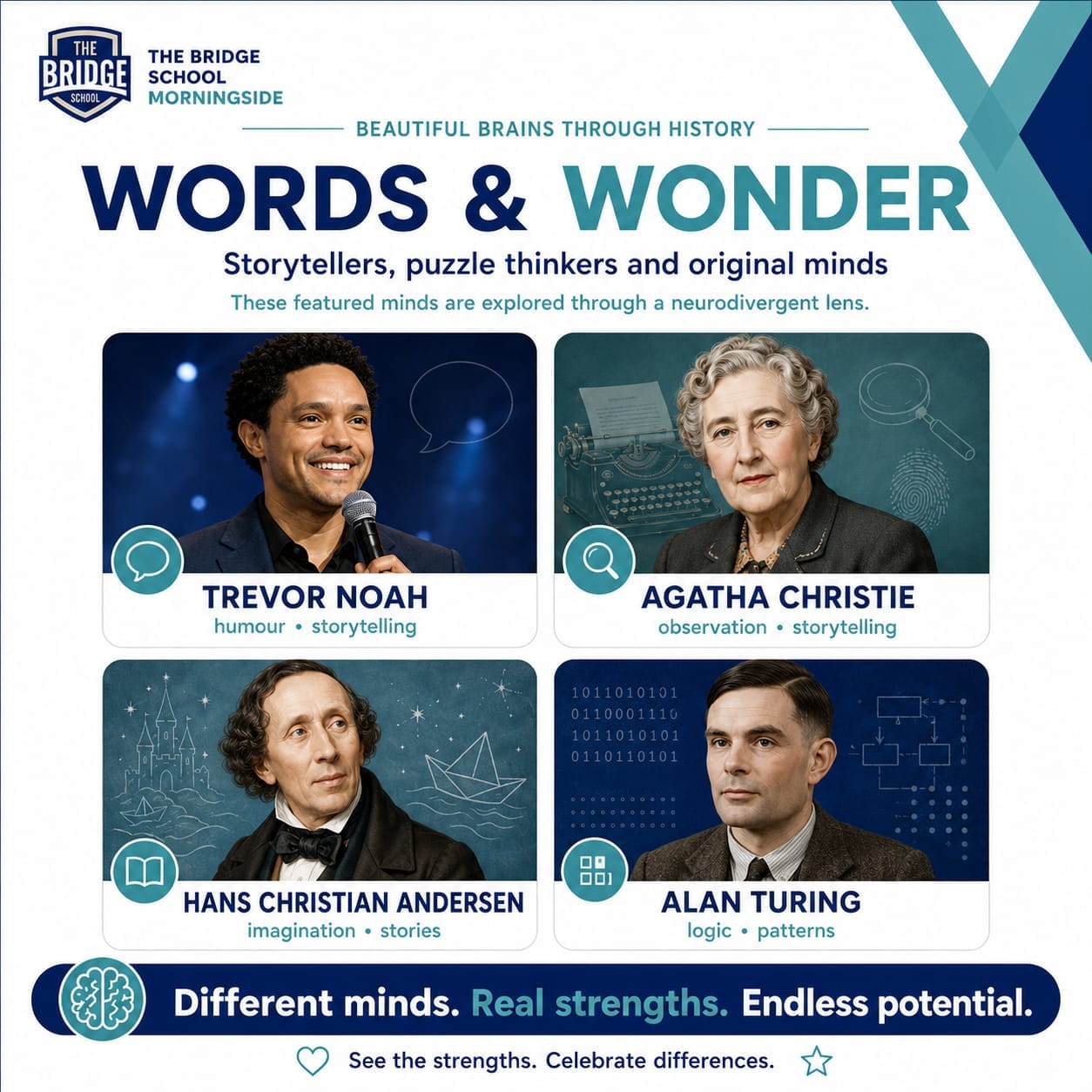
South Africa brought in Trevor Noah, with language, humour, storytelling and the experience of moving between worlds.
Italy centred on Leonardo da Vinci, whose notebooks, sketches, inventions and endless questions showed a mind that did not stay neatly in one subject.
Croatia brought in Nikola Tesla and the kind of imagination that could picture inventions before they existed. Austria gave learners Mozart, rhythm, pattern and intensity. Sweden opened space for Greta Thunberg, focus, justice and the courage to speak plainly about what matters.
The posters around the school carried the idea even further. Learners met Temple Grandin through autism and visual thinking. Simone Biles and Michael Phelps through movement, energy and focus. Marie Curie through scientific persistence. Hans Christian Andersen through dyslexia and storytelling. Agatha Christie, through spelling struggles, clues and puzzle thinking. Archimedes through curiosity and difficult problems.
Not every person was presented in the same way. Some are openly neurodivergent. Some historical figures were included through a careful neurodivergent lens because of how they thought, learned, created, or worked.
The activity was not there to diagnose people from the past. It was there to show children that different minds have always been part of the world.
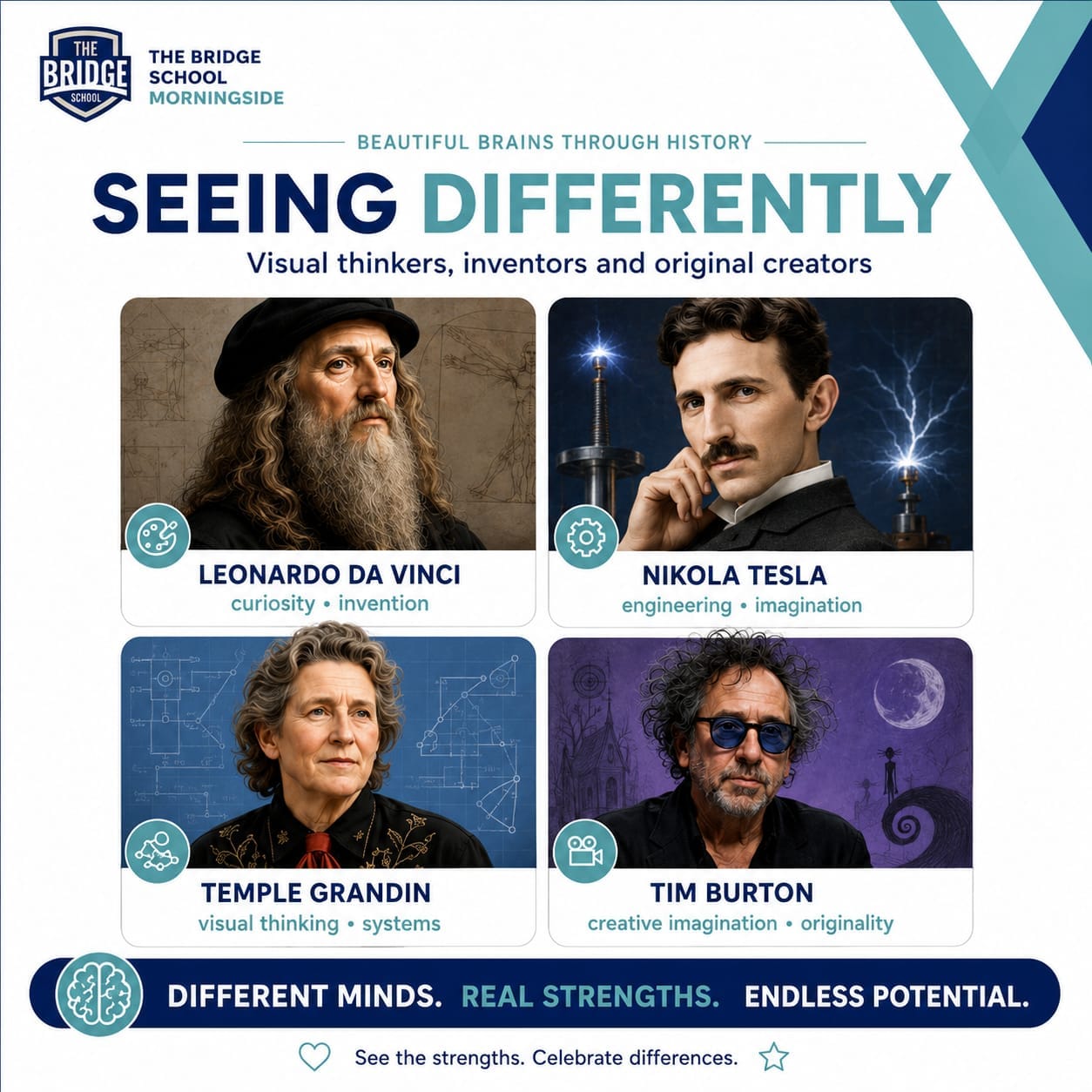
They have shaped science, sport, music, comedy, invention, storytelling, technology, books, art and public life. They have asked unusual questions, noticed things others missed, built things, performed, imagined, challenged, solved and created.
For neurodivergent learners, that is an important thing to see.
So much of childhood can become about what needs support. Reading. Attention. Sound. Movement. Communication. Regulation. A task that does not quite fit. A school system that keeps asking a child to prove themselves in one narrow way.
Those needs are real. Support can be life-changing.
But they are not the whole child.
Beautiful Brains Around the World made space for the other side, too. The curiosity. The originality. The humour. The intensity. The questions. The imagination. The focus. The movement. Ways of thinking that may not always look easy in a classroom can still become valuable in the world.
The children did not have to sit still and listen to that message, but they certainly walked through it.
Before leaving each country station, learners added their fingerprints to a blank flag. As the groups moved through the school, the flags slowly filled, one small mark at a time.
By the end of the morning, the school was full of beautiful brains.
Some were on the posters.
Some were in the stories.
And some were walking from room to room, perhaps seeing a little more clearly that their own way of thinking belonged there too.