When Loving Stories Isn’t Enough: Why Setworks Can Overwhelm Even Passionate Readers


Many parents carry a reasonable assumption about children and reading.
If a child loves stories, surely literature at school should feel easy.
After all, this is often the child who devours films, discusses characters endlessly, invents complex narratives, and analyses plot twists with surprising sophistication.
Yet for many learners, the introduction of prescribed setworks tells a very different story.
Suddenly, the child who loves narratives appears frustrated, avoidant, or overwhelmed.
Homework stretches into hours.
Reading becomes slow and effortful.
Confidence begins to erode.
Not because the learner has lost interest in stories.
But because school reading places very different demands on the brain.
Setworks often combine three major cognitive pressures.
First, volume.
Full-length novels, plays, and dense texts require sustained mental stamina.
Second, language complexity.
Archaic phrasing, unfamiliar vocabulary, layered symbolism, and indirect meaning structures demand constant decoding.
Third, cognitive load.
Learners must simultaneously track plot, interpret themes, retain details, recognise patterns, and prepare for assessment.
For many children, this becomes mentally exhausting.
Parents frequently observe behaviours that feel puzzling at first.
A child rereads the same paragraph repeatedly.
Reading homework triggers irritability or shutdown.
The learner understands the story when explained aloud but struggles to extract meaning independently.
They insist they “hate reading” despite loving stories in other formats.
These reactions are rarely about laziness or lack of effort.
They are often signs of cognitive overload.
Reading is an intensely demanding neurological task. It relies on attention regulation, working memory, language processing, sequencing, and mental organisation. When text density exceeds a learner’s processing comfort zone, fatigue sets in quickly.
Importantly, this can affect highly intelligent, deeply curious learners.
A child may possess strong reasoning skills, excellent verbal insight, and rich interpretive ability, yet struggle with the mechanics of navigating dense academic text.
The difficulty lies not in understanding ideas.
But in managing the pathway to those ideas.
This distinction matters enormously.
Without it, learners may internalise damaging conclusions.
“I’m bad at English.”
“I’m not good at reading.”
“I just can’t do literature.”
In reality, the learner may be contending with processing strain rather than conceptual weakness.
When parents and educators recognise this, the entire narrative changes.
Support becomes targeted.
Stress reduces.
Confidence stabilises.
Because success in literature does not begin with analysis.
It begins with access.
When learners can engage with the story through clearer structure, guided interpretation, visual mapping, or cognitive scaffolding, comprehension improves. Essays become more manageable. Reading becomes less intimidating.
The child who once appeared resistant often re-emerges as the thoughtful, story-loving learner they have always been.
If this reading experience sounds familiar in your home, you are not imagining it.
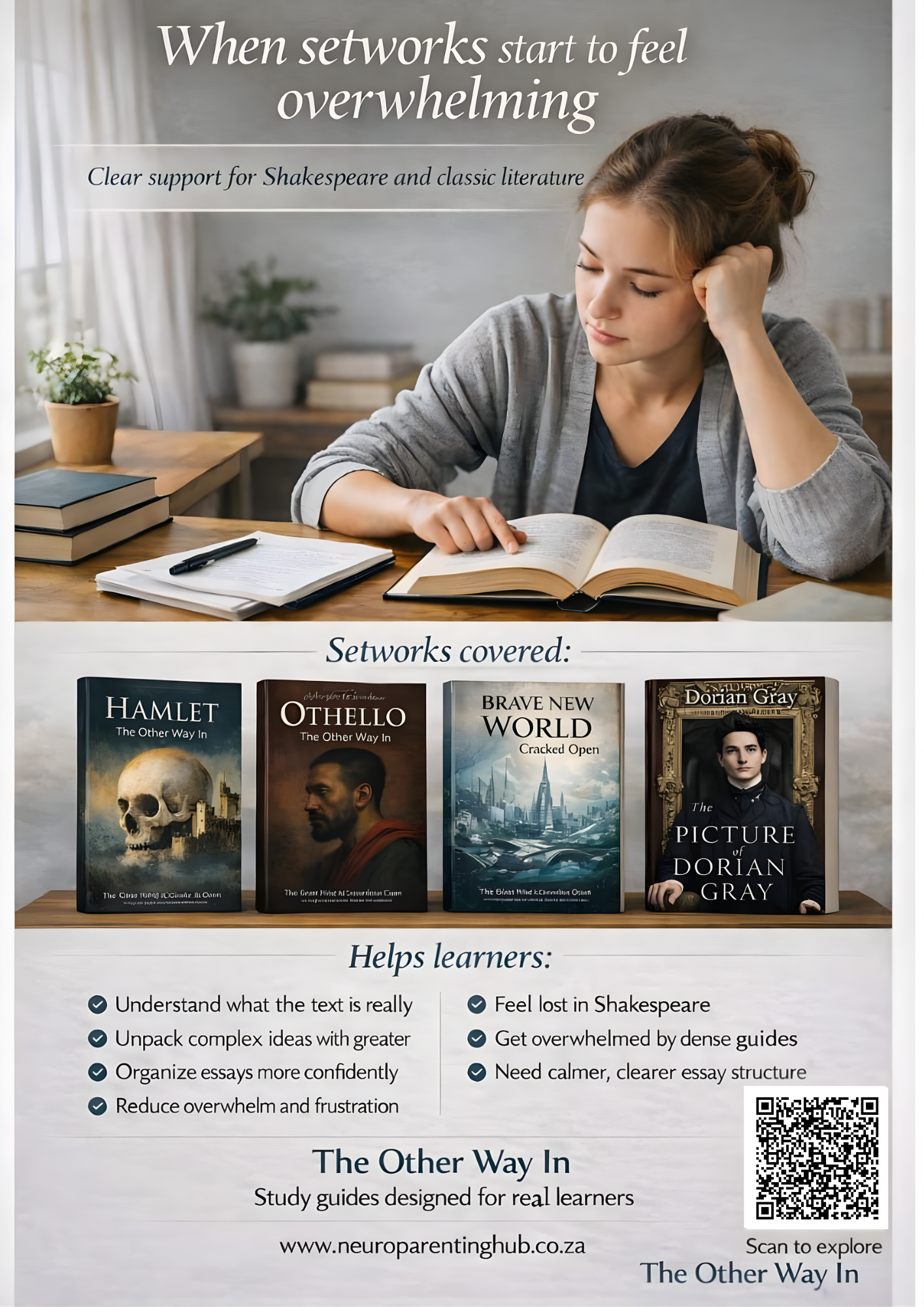
Why The Other Way In study guides were created
The Other Way In study guides grew out of working with learners who genuinely loved stories, ideas, discussion, and interpretation, yet found traditional study guides overwhelming or cognitively exhausting.
Again and again, the same pattern appeared.
Learners who were insightful, curious, and capable struggling not with understanding, but with navigating dense texts, complex language, and memorisation-heavy approaches that simply did not align with how they processed information.
These guides were designed to offer clearer structure and more cognitively supportive pathways into prescribed literature.
Not to simplify the works.
But to make them more accessible.
Expanding the collection
The series continues to grow as new guides are developed across prescribed titles.
Because learners should not have to fight their way into stories.
They should be able to enter them with clarity, confidence, and far less stress.
Explore The Other Way In study guides: www.neuroparentinghub.co.za