
Study methods that actually work for neurodivergent learners

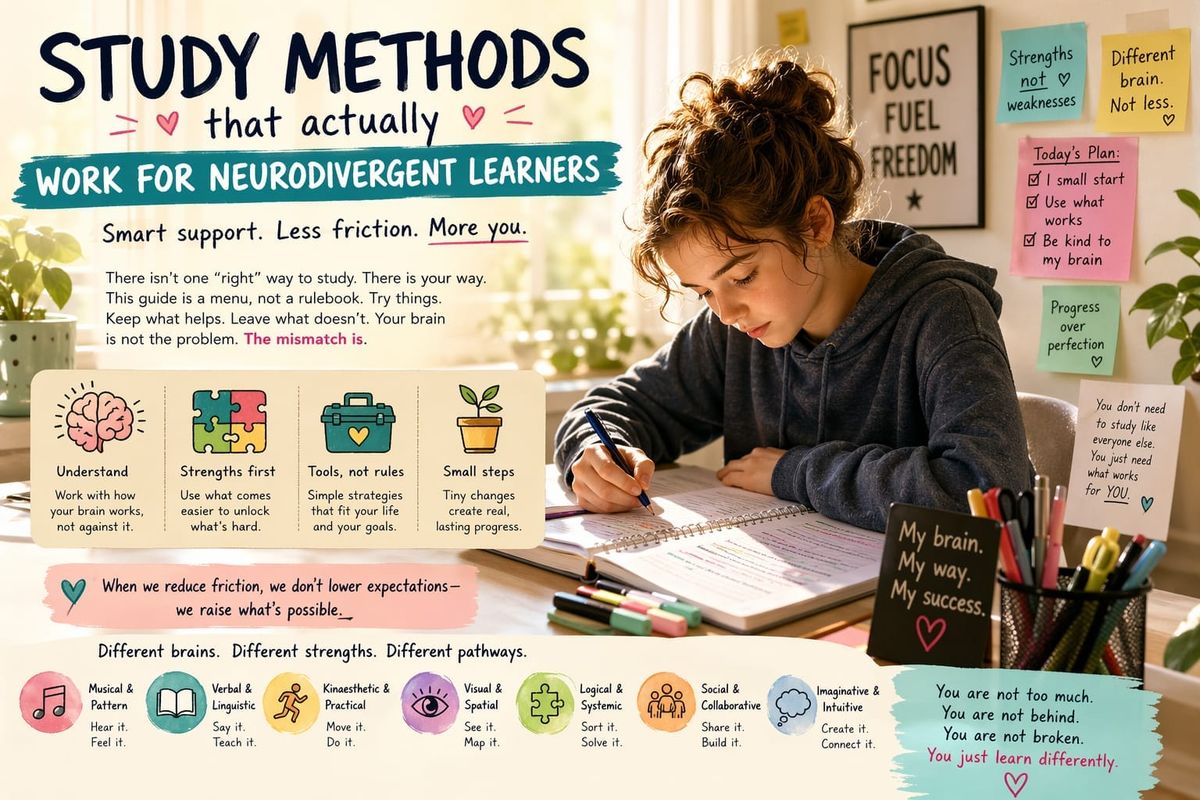
A fuller, more humane guide to helping different brains study in ways they can actually return to.
|
Most study advice is written for learners who can sit down, start
cleanly, stay focused, tolerate the page, and show what they know in neat
little boxes. Plenty of learners cannot do that. This article starts from the
snag instead: where the work catches, what kind of brain is trying to do it,
and which methods genuinely make studying more possible. |
Most study advice is written for a very particular kind of learner. A learner who can sit down on command, tolerate the page in front of them, hold several instructions in mind, ignore the dog barking and the buzzing light and the sibling in the next room, push past boredom, organise the task, estimate the time, and then calmly prove what they know in the format somebody else has decided counts. That learner does exist. Plenty do not.
This is where so much study guidance falls apart. It keeps offering the same bland little commandments. Break it down. Stay organised. Use a timer. Find a quiet space. Revise regularly. Be consistent. None of those things is wrong. They are just nowhere near enough when the real problem is that the work will not go in, the brain will not start, the room is too loud, the page is too dense, the learner is burnt out before homework even begins, or the child can explain the whole topic beautifully in the car and then falls to pieces the moment a worksheet appears.
That gap matters because neurodivergent learners are so often judged at the point of struggle instead of understood there. What looks like procrastination may be task paralysis. What looks like inattention may be sensory overload. What looks like carelessness may be working memory falling apart in real time. What looks like laziness may be a brain that has spent the whole day coping and has nothing left for the neat little performance of homework.
So this is not about making neurodivergent learners more compliant. It is about making studying more possible. It means choosing methods according to the kind of friction a learner hits, the strengths they already have, the challenges that keep catching them, and the level of energy they actually have on the day. A study method is only useful if a learner can return to it in real life, on ordinary Tuesdays, with ordinary stress, imperfect motivation, and a nervous system that does not always play along.
Start with the snag, not the label
One of the biggest mistakes adults make is assuming that all study problems belong in the same basket. They do not. A learner who cannot get started needs something different from a learner who starts well but remembers nothing. A learner who reads slowly and laboriously may need a completely different route in from a learner who loves reading but cannot organise their thoughts on paper. A child who is fine at school and implodes at home is telling you something different again.
That is why it helps to think in terms of the snag. Not the tidy label. Not the adult assumption. The snag.
|
If the snag is ... |
It may look like ... |
The learner may need ... |
|
Starting |
Stalling, wandering, endless delay, suddenly needing water or
stationery |
A tiny first step, body doubling, spoken planning |
|
Reading |
Slow progress, skim-reading without meaning, tears, shutdown |
Text-to-speech, chunked text, previewing, guided notes |
|
Remembering |
Knew it yesterday, blank today |
Retrieval practice, repetition, movement, voice notes |
|
Writing it down |
Can say it but cannot get it onto paper |
Oral rehearsal, scaffolds, sentence starters, speech-to-text |
|
Organisation |
Lost sheets, forgotten tasks, late projects |
Visual systems, one landing place, checklists, backward planning |
|
Regulation |
Meltdowns, irritability, fidgeting, refusal |
Breaks, decompression, sensory support, lower-demand entry |
|
Test performance |
Knows it but freezes, rushes, misreads |
Practice with format, command-word work, safer retrieval pressure |
Ask the better question
Before choosing a method, ask what is actually going wrong here. Not what should be easy. Not what the teacher thinks ought to happen. Not what worked for an older sibling. What is the sticking point in this moment?
Can the learner not start. Can they start but not sustain. Can they understand but not retain. Can they retain but not retrieve. Can they speak but not write. Can they do it at school but not after school. Can they manage the task but not the environment. That question changes everything.
Getting over the threshold
For a lot of neurodivergent learners, the hardest part of studying is not the content. It is the threshold. The moment before the work begins. Adults often read this as avoidance because it looks like avoidance. The child wanders. The teenager reorganises a pencil case. Somebody suddenly needs water. Somebody else remembers an urgent thought about dinosaurs, football, or whether the cat is asleep. It can look ridiculous from the outside. It often feels awful from the inside.
The task may be too vague. Too long. Too boring. Too exposed. Too full of invisible steps. The learner may not know where to put their attention first. That creates drag. The drag gets read as attitude. Then everybody is in trouble.
The answer is usually not a lecture. It is a better entry point. A good first move is concrete and visible. Not “revise history”. Not even “finish your notes”. Try: circle the dates, read the first paragraph with the audio on, answer one question, highlight three key terms, put the books in order, say the topic out loud, write one heading. Tiny verbs help because they give the brain somewhere to stand.
Body doubling can help here too. Some learners start more easily if another human is simply nearby. Not directing. Not hovering. Just there. A parent folding laundry at the same table can sometimes do more than ten reminders shouted from the kitchen. For learners who freeze at the thought of a full task, spoken planning can be better than written planning at first. “Tell me what you’d do first” is often more useful than “Write a study plan.”
|
Start-small ideas • Open the book and find the page
only. • Read the title and say what you
think it is about. • Highlight three words you already
know. • Answer the easiest question
first. • Set a five-minute timer and stop
if needed. • Tell somebody the first thing you
notice. • Listen to the first paragraph
instead of reading it silently. |
Dense reading can turn studying into hard labour
Reading is not neutral. For many neurodivergent learners, a dense page is not simply some work. It is visual clutter, tracking strain, decoding effort, mental traffic, and the sinking feeling of too much before the first line is even finished.
This is why bad study advice can sound almost offensive. “Read the chapter carefully” is only useful if careful reading is an accessible act. For some learners, it is not.
There are better ways in. Text-to-speech can ease the load. Reading while listening can support comprehension. Wider spacing, fewer distractions on the page, chunked sections, key-word previews, and guided questions can all reduce the amount of energy spent just trying to survive the text.
It also helps to separate reading for access from reading for depth. A learner may first need to hear or skim the material in a supported way before going back to study the details. That is not cheating. It is how many people learn.
|
If
reading is the problem ... |
Try this
instead ... |
|
The page feels overwhelming |
Cover parts of the page and reveal one section at a time. |
|
Silent reading leads to drift |
Read and listen together using TTS or audio. |
|
The learner forgets what they just read |
Pause after a short section and say it back. |
|
The text is too abstract |
Preview key words and the main idea first. |
|
Notes become a mess |
Use guided headings or fill-in frameworks. |
|
The learner gives up quickly |
Begin with a summary, diagram, or explainer video. |
Knowing it is not always the same as being able to hold it
This is one of the most maddening patterns for families and teachers. The learner clearly understands the topic. You hear it in conversation. You hear it in the questions they ask. You hear it in the strange but brilliant analogy they make while brushing their teeth. Then the next day it is unavailable.
Working memory and retrieval both matter here. Some learners can process information beautifully in the moment but cannot keep enough of it live in their heads to manipulate it, organise it, or get it down on paper. Others do store it, but retrieval under pressure is patchy. The result is the same kind of heartbreak. “But you knew this yesterday.”
That is why passive revision is often such a trap. Re-reading can feel reassuring because the information looks familiar. Familiarity is not the same as recall.
Real retention usually needs the learner to do something with the material. Cover and say. Draw and label. Sort and match. Teach it to someone else. Turn it into a voice note. Answer a question without looking. Rebuild the idea from scraps.
Movement can help memory too. Walking while recalling facts, using cards around the room, tossing a ball while answering, stepping through a timeline, clapping a sequence, acting out a process - these are not silly extras for some learners. They are the memory path.
|
Ways to make revision stick • Use flashcards with very short
prompts. • Say the answer before turning the
card over. • Teach the topic to a sibling,
mirror, pet, or imaginary audience. • Create a one-minute voice note
summary. • Draw a timeline, cycle, chart, or
sequence from memory. • Use mini whiteboards for quick
retrieval and correction. • Swap re-reading for self-testing. |
Getting knowledge onto paper
A child may know the answer and still not be able to write it neatly, quickly, or coherently. A teenager may talk brilliantly and produce flat, tangled writing. An oral thinker can sound articulate and then look underprepared on the page. Adults often miss how painful this gap can be.
Writing makes multiple demands at once. Hold the idea. Organise it. Recall the wording. Manage spelling. Sequence the sentence. Form the letters or type efficiently. Keep going. Stay calm. For some learners, that is a traffic jam.
Support needs to recognise that. Oral rehearsal is powerful. Ask the learner to say the answer first. Record it. Then pull out the shape of it. What is the main point. What comes first. What detail supports it. Sentence starters can help. So can paragraph frames, speech-to-text, bullet-first drafting, and writing from a spoken explanation rather than from a blank page.
|
If the
learner can say it but not write it ... |
Helpful
supports |
|
Ideas come out faster than writing |
Voice notes, speech-to-text, oral rehearsal. |
|
The blank page causes panic |
Sentence starters, writing frames, guided prompts. |
|
Thoughts are jumbled |
Bullet points first, then expand. |
|
Spelling slows everything down |
Draft for ideas first, edit later. |
|
Handwriting is exhausting |
Typing, oral responses, reduced copying. |
|
Essays feel shapeless |
Paragraph scaffolds and model structures. |
Organisation can swallow a bright learner whole
Some children understand the work well enough. What ruins them is the architecture around it. The sheet is missing. The date is wrong. The project was due today, not tomorrow. The maths book is at school. The instructions were on another platform. They meant to do it. They really did.
This is the kind of thing adults are tempted to moralise because it looks avoidable. But executive function difficulty is real. It can make bright learners look careless, lazy, or impossible when the real problem is that the system expects too much internal organisation from a brain that does better with external structure.
The answer is not to keep saying, “You need to be more organised.” The answer is to build systems that are visible, simple, repeatable, and hard to lose.
One-place rules help: one folder for current work, one visible homework list, one tray or basket for school papers, one routine for packing up, one place where finished work goes.
Colour-coding can help some learners, especially when it is consistent and not overcomplicated. Photographs of homework instructions can help. So can checklists stuck inside a file, a wall planner, a timer for pack-up, and breaking projects into dated mini deadlines rather than one final horror at the end.
Backward planning is especially helpful. Instead of “It’s due Friday”, ask what has to be done tonight, what can wait, what is the smallest version that still counts as real progress, and what would help future-you tomorrow.
The environment can help or make everything worse
Adults love to say “Find a quiet place” as if that solves anything. Quiet for whom. Still for whom. Comfortable for whom. Some learners need reduced noise and less visual clutter. Others need background sound, a little movement, a hoodie, music without lyrics, chewing gum, a lamp instead of the main light, or permission to pace while recalling information.
The point is not to create an Instagram study corner. It is to notice what lets the nervous system stay online.
A good study setup may include fewer objects in sight, the right level of sound, lighting that does not irritate, a fidget or sensory tool if needed, water nearby, a chair or posture the learner can tolerate, and an agreed backup plan for losing focus.
That last one matters. Many learners are not destroyed by losing focus. They are destroyed by what happens after losing focus. Nobody has taught them the recovery move.
|
Recovery moves • Stand up and stretch. • Switch to a shorter task. • Read aloud instead of silently. • Change location. • Use a whiteboard instead of a
book. • Take a timed sensory break. • Ask someone to sit nearby. • Say the next step out loud. |
After-school homework is its own battlefield
Home is not simply school continued by other means. Many neurodivergent learners spend the day managing themselves. Following instructions. Holding it together. Masking confusion. Managing noise, transitions, social pressure, and expectations. By the time they get home, the tank is low.
Then an adult says, “Right, let’s get your homework done.” And everyone wonders why things explode.
Some children need decompression before learning can happen again. Food. Quiet. Movement. Screen downtime. A shower. Time in the garden. A familiar routine that lets the nervous system come back down before any academic demand appears.
Parents also need clarity. Homework falls apart faster when the task is vague, the purpose is unclear, or the expected time is ridiculous. A worksheet that “should only take ten minutes” can easily become forty if reading, writing, attention, regulation, and resistance all pile on top of each other.
|
A more realistic homework sequence • Arrive home. • Decompress properly. • Check exactly what the task is. • Reduce the first step. • Decide what support is allowed. • Work in short bursts if needed. • Stop before everyone is
shattered. |
Different strengths call for different study methods
This is where adults need to get more generous. Neurodivergent learners are often described through deficits only. That misses half the picture. Many of them have strong pattern recognition, unusual memory hooks, deep verbal ability, visual imagination, bodily intelligence, practical reasoning, or a gift for making things real. Study methods work best when they use what is already strong.
|
Learner
strength or natural route in |
Study
ideas that often fit well |
|
Musical and pattern-noticing |
Turn facts into chants, rhythm patterns, or melody hooks; group
information by sound or repeated structure; clap stages in a process; use
pattern spotting in language, formulae, or historical cycles. |
|
Strong talkers and verbal processors |
Explain it to someone else; record voice notes; rehearse essays out
loud; use mock interviews or mini debates; teach the topic as if presenting a
podcast; summarise it as if texting a friend. |
|
Doers and learn-by-doing learners |
Role-play a scene or process; build a model; sort cards on the floor;
sequence events across a room; use practical demonstrations; turn revision
into movement stations or gesture-based recall. |
|
Highly visual and creative thinkers |
Use visual timelines, sketch notes, simple mind maps, comic-strip
summaries, colour-linked categories, diagrams, arrows, symbols, comparison
grids, and memory images for key facts. |
|
Logical and system-seeking learners |
Classify information into groups; spot rules and exceptions; build
if-then charts; compare similar concepts side by side; repair broken
sequences; sort examples and non-examples; turn revision into a puzzle of
connections. |
|
Social learners |
Use study buddies with clear roles, question trading, paired whiteboard
work, mini quizzes, collaborative recall games, group explanation of a hard
topic, and take turns teaching sections. |
|
Imaginative learners |
Turn content into a story; give concepts characters or voices; build a
world around a topic; use metaphor to explain abstract ideas; picture
processes as scenes; link facts to narrative sequences. |
Different challenge patterns need different supports
|
Challenge
pattern |
Supports
that often help |
|
ADHD and time blindness |
Visible timers, external deadlines, body doubling, short sprints,
novelty, spoken planning. |
|
Dyslexia and reading strain |
TTS, audio support, chunked text, visual spacing, reduced copying, oral
rehearsal. |
|
Autism and overload |
Predictability, decompression, sensory-aware spaces, clear
instructions, lower language clutter. |
|
Working memory weakness |
One step at a time, visual cues, checklists, repetition, say-it-back
routines. |
|
Slow processing |
More time, previewing, fewer rushed transitions, reduced pressure at
the start. |
|
Study anxiety |
Clear expectations, smaller chunks, no surprise overload, compassionate
pacing. |
|
Perfectionism |
Good-enough targets, drafting permission, visible progress steps, less
fear of getting it wrong. |
Low-capacity days need their own plan
Not every day is a full-capacity day. Some afternoons are brittle from the beginning. Some evenings the learner is depleted, overwhelmed, over-socialised, under-slept, hungry, discouraged, or simply done.
That is not the moment for grand speeches about resilience. A good study system includes a bad-day version.
|
Bad-day version • Do one reduced but real task. • Use the easiest route in. • Choose support without guilt. • Stop aiming for perfect notes. • Focus on retrieval of one small
area. • Let oral work count where
possible. • Decide what can wait. • Protect the relationship as well
as the task. |
Tiny protocols people can actually use
|
If reading is hard • Preview the title and key words. • Listen to the first section if
possible. • Read one small chunk only. • Say what it meant in ordinary
language. • Write one note, not ten. |
|
If the learner freezes before writing • Ask them to say the answer out
loud. • Pull out the main point. • Write bullets first. • Turn one bullet into one
sentence. • Build from there. |
|
If revision keeps going in one ear and out the other • Close the book. • Say or write everything
remembered. • Check for gaps. • Focus only on what is missing. • Test again later. |
|
If homework always starts with a fight • Build in decompression first. • Check the exact task together. • Cut the first step down. • Sit nearby if needed. • Stop before everyone is wrecked. |
What adults need to remember
Teachers and parents often end up holding the emotional edge of all this. They are tired too. They are trying. They are often dealing with systems that do not make much room for difference. But it helps to remember a few things.
|
Hold onto these • A learner can be bright and still
need heavy scaffolding. • A child who resists may be
overwhelmed, not unwilling. • If a study method only works on
good days, it is not yet a reliable method. • Neat, silent compliance is not
the same as learning. • A learner who talks brilliantly
may still need support to write. • The child who falls apart at home
may have held themselves together all day. |
The point is not to make the learner look normal
That is worth saying plainly. The point is not to scrub away every sign of difference until the learner looks tidy enough for the system. The point is to help them access knowledge, hold onto it, make sense of it, and show what they know with less unnecessary pain.
Sometimes that will mean timers and lists. Sometimes it will mean movement, music, body doubling, oral rehearsal, diagrams, recovery breaks, or a quiet lamp in the corner instead of the big light. Sometimes it will mean accepting that the old method is not noble. It is just ineffective.
The best study system is not the most beautiful one, or the strictest one, or the one that sounds impressive to other adults. It is the one a learner can return to. Repeatedly. Imperfectly. In real life. That is the standard worth aiming for.
|
A final word Most neurodivergent learners do not need more shame wrapped up as
discipline. They need adults who can tell the difference between defiance and
overload, between laziness and strain, between a child who will not and a
child who cannot do it that way today. Good study methods do not begin with blame. They begin with attention.
What catches this learner. What helps. What drains them. What gets them over
the threshold. What lets them come back tomorrow. That is how studying becomes possible. Not perfect. Not pretty.
Possible. And for a great many learners, that is where everything starts. |